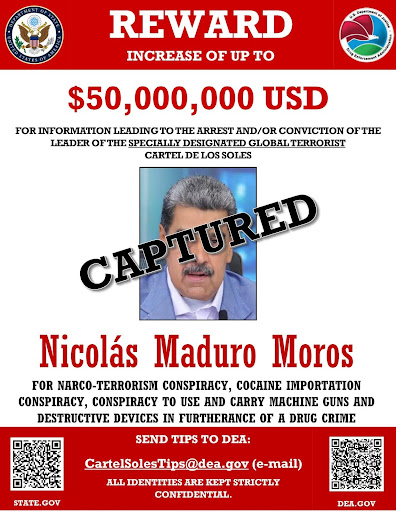
Oil-rich Venezuela, seen by both Moscow and Beijing as a prospective ally in the western hemisphere, was taken over by old Uncle Sam on January 3, 2026, with President Trump now threatening more military action in the Danish territory of Greenland. The president-turned-dictator, Nicolás Maduro, was captured on charges of narco-terrorism and drug trafficking. This takeover is politically known as Operation Absolute Resolve, but what issues did this takeover ‘absolutely resolve’?
America carefully instrumentalized the fall of the oil giant behind veils of narco-terrorism, drug trade containment and trafficking charges. However, this doesn’t mean the fall of Maduro was a bad thing for the people of Venezuela or for America. In many people’s eyes, it can be seen as a win-win situation, with the U.S. getting access to a very large amount of oil while the people of Venezuela are released from the 12-year dictatorship of Maduro.
History teacher Ms. Zupancic adds, “I think a big part of the division comes from the political climate we’re living in right now, which is already highly polarized. In today’s environment, almost any major government action — especially one involving military force — gets filtered through partisan lenses very quickly. On top of that, Americans tend to agree more easily on ends — like opposing authoritarianism or corruption — than on means. Some people focus on the idea that removing a tyrannical leader is morally justified, while others are more concerned about how it was done, what precedents it sets and whether it aligns with democratic values.”
Washington viewed Venezuela as a democratic ally in Latin America, with multiple trade agreements, oil infrastructure development and sustained mutual ties, until the late 1990s, when Hugo Chavez assumed power with the Bolivarian ideology to promote resource nationalism and undermine the authoritarian figure of the White House. This shift transformed a strategic partner into a strategic adversary, with Caracas seeking China and Russia for funds, trade and mutual economic growth. Since 2013, Maduro has been ruling Venezuela in the face of severe economic and political collapse, relying on ideological positioning and mass conditioning for his political foothold.
The White House said Venezuela’s interim government must take orders from the U.S., despite Venezuela’s interim leader, Delcy Rodriguez, insisting no foreign power is in charge. In addition to top U.S. officials, detailed plans to control the proceeds of Venezuelan oil sales were announced, with the proceeds said to benefit the Venezuelan and American people, as determined by the U.S. government. The White House also says it is too early to discuss when future elections will take place in Venezuela.
Mr. Schwab remarked on the military effort, describing it as exceptional and a testament to the advancement of U.S. military capabilities: “What other country can shut off the power to an entire nation, blow up all their SAMS, have zero casualties while killing 100 Venezuelans and then kidnap that country’s leader?” said Schwab.
An anonymous Venezuelan guard described an “intense sound wave” that felt like an “explosion… inside my head.” He claimed soldiers “started bleeding from the nose” and “some were vomiting blood” before collapsing, unable to move. In an interview published by the New York Post, both the White House and the Pentagon declined to comment on whether any sonic or directed-energy systems were used in the attack.
The Venezuelan people have been seen on social media celebrating and praising the liberation of their country, while some argue that there are deeper-rooted motives behind the military action. However, most can agree that the people of Venezuela deserve their freedom and the right to be prosperous. Maduro and his wife both pleaded not guilty to the charges brought against them in court.
Zupancic comments, “‘[Doing something] right’ often depends on the standards you’re using. From one perspective, the administration acted on long-standing criminal charges and used its military and intelligence capabilities to carry out a complex operation. From another perspective, critics argue that using force in a sovereign country raises serious legal and ethical questions. So I think it’s fair to say the administration achieved its goal, but whether it was the ‘right way’ depends on how much weight you give to international law, diplomacy and precedent.”
As Washington navigates its new role in Venezuela, the vision for the country’s future governance and potential elections remains undecided. While voices within Venezuela assert sovereignty and resistance against foreign intervention, the reality is a delicate balance of power, oil interests and geopolitical strategies, all set against a backdrop of historic animosity. The coming months will be crucial not only for Venezuela but also for U.S. relations in Latin America and beyond.