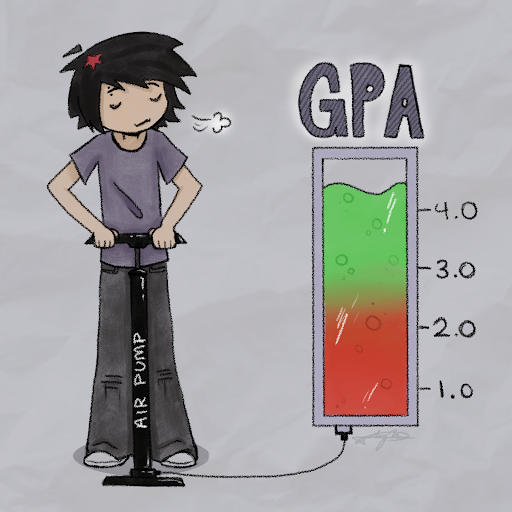
With the turn of the semester, college admissions and high school juniors start to think about their transcripts; grades are the common factor and biggest worry. Gradeflation is a conflicting topic surrounding the education system that many people have strong opinions on, including the Hiller staff.
The term “gradeflation,” also known as grade leniency, is assigning higher grades than students deserve to keep a certain letter grade or GPA; this devalues grades and can lower the motive for students to succeed. This situation often occurs when teachers grade based on motivation, rather than skill and knowledge.
Leniency on grades became more apparent during the 2020 COVID-19 lockdown. As kids didn’t complete many assignments in the first place, teachers were content with any work that was submitted. Since then, numerous schools around the world have been adapting their grading systems to not discourage students. According to the Los Angeles Times, some school districts in California are taking away the D and F grades in hopes to incentivize their students.
Staff Writer Aliyah Emery doesn’t personally feel that she’s experienced grade inflation, but she feels that the whole phenomenon is unfair.
“Students expect to receive higher grades and they get off easier, especially after the pandemic. No one failed in the lockdown,” Emery contributed.
One thing gradeflation has warped is the college admissions process. Colleges look at grade-point averages to see how a student would do in a higher-education setting, but if many students are getting undeserved 4.0 GPAs, how do they differentiate students? More universities are starting to bring back the required SAT and ACT scores for this reason.
Arts and Entertainment and Media Editor Katherine Drezewski feels the same way as Emery also commenting that A grades shouldn’t come as easily, like it did in the past.
“I think that [gradeflation] can be somewhat good because GPAs are the first things that college admissions officers look at when looking at students. However, this is not an accurate representation of a student because if a student tries hard enough, it’s not difficult to get a high GPA anymore,” Drezewski explains.
Any juniors at THS should not fear about their futures in the midst of the gradeflation epidemic; there are many ways to stand out in college admissions! Having interesting extracurricular activities, being involved in clubs and the community and writing a strong personal essay are all parts of the admissions process that grade inflation can’t affect.
Without a doubt, students can’t fix gradeflation. Working hard, keeping up on assignments and staying motivated in school are only some of the things that kids can do to pave their own way to success.